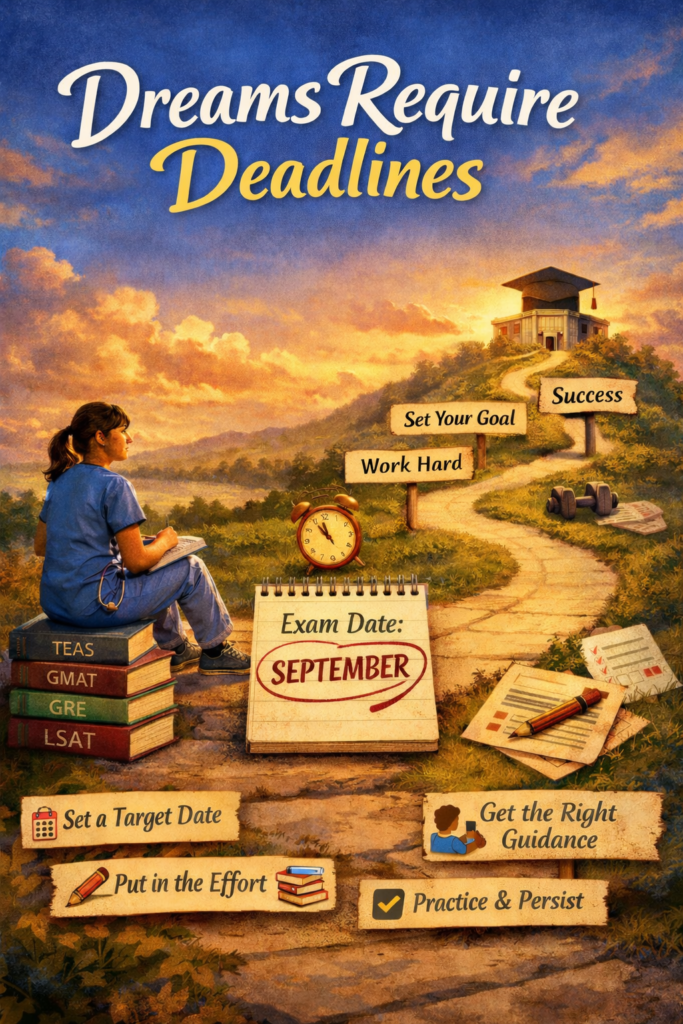

Success on exams like the TEAS, GMAT, GRE, or LSAT is often described as a matter of intelligence. This is comforting for people who pass and discouraging for everyone else. But the truth is far less dramatic and far more useful: success on these exams is mostly about direction, effort, and persistence. In other words, it starts with a dream, turns into a goal, and is built through a lot of disciplined work.
Let’s start with the dream.
Most adults who return to test preparation already have one. It might be becoming a nurse, advancing in business, going to law school, or opening the door to graduate study. Unlike the dreams we had at sixteen (“maybe I’ll be a rock star”), these are practical dreams. They are tied to real life: better careers, stability, and meaningful work.
But dreams alone are not enough. Dreams are wonderful, but they are also lazy. They sit around comfortably in your mind until you convert them into something more serious: a goal.
A goal has a date attached to it.
“I want to go to nursing school someday” is a dream.
“I will take the TEAS exam in September” is a goal.
That small shift is powerful. Once a date exists, your brain stops treating the idea like a pleasant fantasy and starts treating it like a project.
Of course, setting a goal creates a new problem: now you actually have to do the work.
And this is where many adult learners hesitate—not because they lack ability, but because they underestimate the process. Standardized exams are not puzzles you solve with sudden brilliance. They are closer to athletic training. No one runs a marathon because they felt inspired one afternoon. They run it because they trained, repeatedly, even on days when the couch looked very convincing.
Preparation works the same way.
Success usually comes from long hours of focused practice. Not glamorous hours. Not Instagram-worthy hours. Just steady, quiet work: solving practice questions, reviewing mistakes, learning concepts, and trying again.
The good news is that adult learners actually have a major advantage here. They already know how discipline works. They’ve held jobs, met deadlines, managed responsibilities, and survived meetings that could have been emails. Compared to that, a few hours of practice problems is not impossible.
Still, effort alone is not enough. Hard work without direction can feel like wandering through a maze with great enthusiasm but no map.
That’s where guidance matters.
Every challenging exam has patterns, strategies, and traps that are easier to see when someone points them out. A good teacher doesn’t simply give answers; they show you how the test works and neat tricks. Once you understand the structure—why questions are designed the way they are—you stop fighting the exam and start playing it intelligently.
Think of it like playing chess. You could move pieces around randomly for years, or you could spend a little time learning the principles of the game and clever strategies. Suddenly, the board makes sense and winning looks easier.
But even with guidance, there is one ingredient that cannot be skipped: practice.
Lots of it.
Practice is where understanding becomes skill. The first time you attempt a difficult reading passage or a complex math problem, it may feel slow and awkward. By the twentieth time, something interesting happens. Your brain begins to recognize patterns. Questions that once looked intimidating begin to look familiar.
This transformation is not magic. It is simply repetition doing its quiet work.
And there will be moments along the way when motivation disappears. This happens to everyone. Some evenings you will feel brilliant and productive. Other evenings you will stare at a problem and wonder whether your brain has temporarily left the building.
That’s normal.
Progress is rarely dramatic. It is usually gradual and a little boring—until one day you take a practice test and realize your score has improved more than you expected.
Those moments are the payoff for all the invisible work that came before.
So if you are thinking about preparing for one of these exams, remember the simple formula:
Start with a dream.
Turn it into a clear goal with a timeline.
Work hard and consistently.
Seek the right guidance.
Practice until the unfamiliar becomes familiar.
None of this is mysterious. None of it requires genius. What it requires is commitment and a willingness to keep going when the process feels slow.
But that is exactly how meaningful goals are achieved.
And someday, when you are sitting in the career or program you worked toward, the long hours of preparation will seem much smaller in comparison to the door they helped you open.