Exams have a strange superpower: they can turn perfectly intelligent students into people who suddenly forget the capital of France, the quadratic formula, and occasionally their own names.
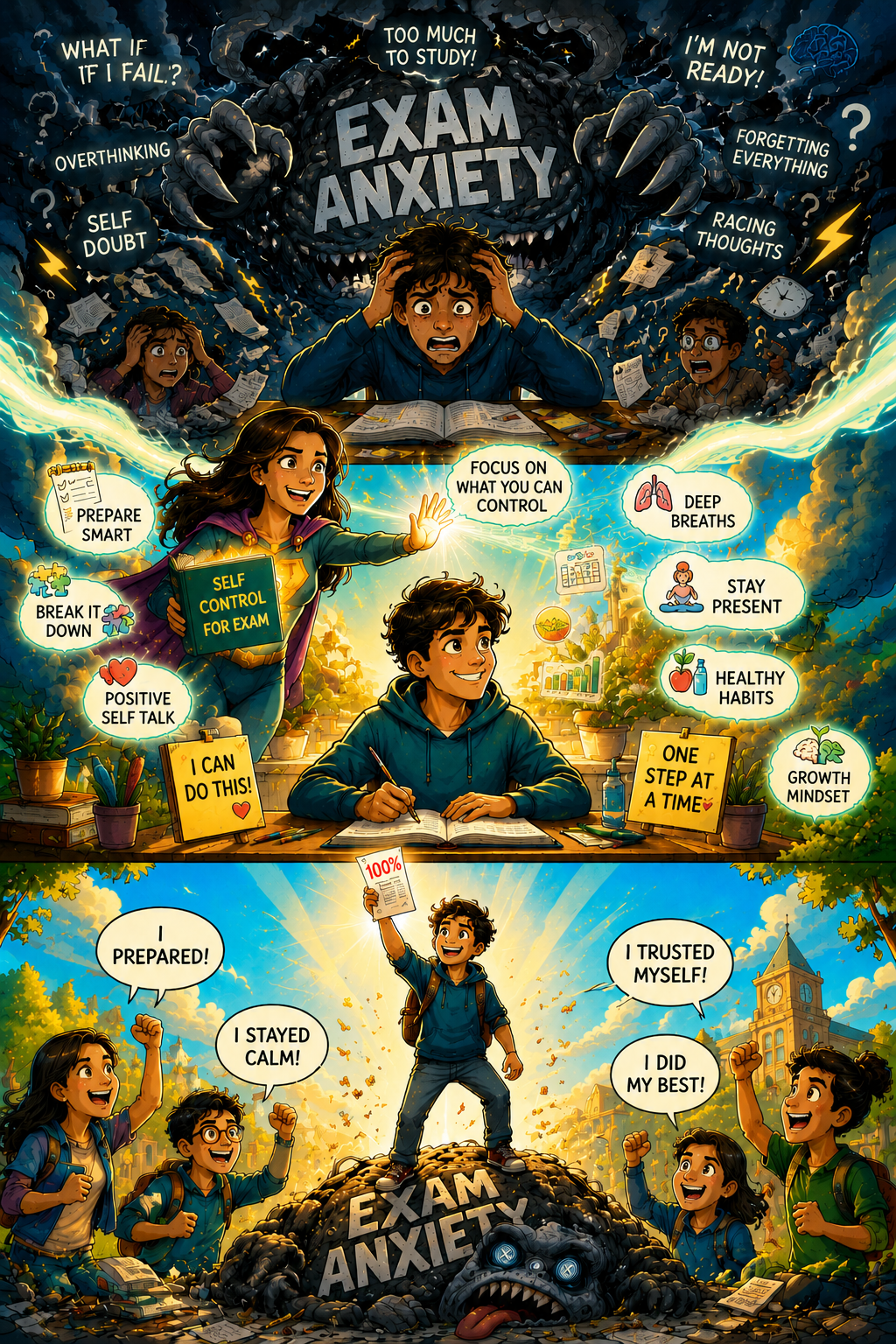
If you’ve ever walked into an exam feeling confident, only to have your brain freeze like a computer with too many tabs open, you’re not alone. Exam anxiety is incredibly common among students preparing for tests like the SAT, ACT, AP exams, GRE, GMAT, or LSAT. The good news? Anxiety is not an unstoppable monster. It’s a system in your brain—and systems can be managed.
Let’s talk about how.
1. Understand the Enemy: Anxiety Is a Biological Reaction
The first step in controlling exam anxiety is realizing that it’s not a character flaw. It’s biology.
When your brain senses a high-stakes situation, it activates the fight-or-flight response. Stress hormones like adrenaline and cortisol flood your body. Your heart beats faster. Your breathing speeds up. Your muscles tense.
Originally, this system evolved to help humans survive dangerous situations—running from predators or reacting to threats.
But today, your brain sometimes treats exams as if they were life-or-death events.
Once you understand this, anxiety becomes less mysterious. It’s simply your brain trying—overenthusiastically—to protect you.
2. Preparation Is the Most Powerful Anxiety Killer
Nothing reduces anxiety like preparation.
Your brain fears uncertainty. When you don’t know what might appear on a test, your imagination fills the gaps with worst-case scenarios. But preparation replaces uncertainty with familiarity.
Practice tests are especially powerful. They train your brain to recognize the exam environment: the timing, the question formats, the pressure.
Think of it like sports. A basketball player doesn’t practice only once before a championship game. They rehearse the same shots hundreds of times until the body knows what to do automatically.
The same principle applies to exams. The more your brain experiences exam-like situations, the less threatening they feel.
3. Train Your Brain to Slow Down
When anxiety spikes, your breathing usually becomes shallow and fast. This signals your nervous system to stay in “emergency mode.”
Fortunately, breathing works both ways. If you intentionally slow your breathing, your brain receives the opposite signal: things are safe.
A simple technique works surprisingly well:
Inhale slowly for four seconds.
Hold for four seconds.
Exhale for six seconds.
Repeat this for one minute before starting an exam or when panic appears during a test. It’s like pressing the reset button on your nervous system.
It may sound simple—but neuroscience strongly supports the effect of controlled breathing on stress regulation.
4. Change the Story in Your Head
Psychology research shows that anxiety often grows from the stories we tell ourselves.
Students frequently think things like:
“If I fail this test, my future is ruined.”
“Everyone else is smarter than me.”
“I’m terrible at exams.”
These thoughts amplify stress.
A better strategy is reframing the situation. Instead of seeing the exam as a threat, treat it as a challenge.
Athletes use this trick all the time. The physical symptoms of anxiety—racing heart, adrenaline, alertness—are actually the same symptoms athletes feel before competition.
In other words, your body may not be panicking. It may simply be preparing for performance.
5. Break the “Perfection Trap”
Many students experience anxiety because they believe they must perform perfectly.
But perfection is a dangerous goal. It creates enormous pressure and leaves no room for mistakes.
High performers often think differently. They focus on doing their best overall, not answering every question flawlessly.
During an exam, if a question seems impossible, skip it and return later. One difficult question does not define the entire test.
Exams reward persistence, not perfection.
6. Build Exam-Day Habits
Small habits on exam day can significantly influence anxiety levels.
Sleep well the night before. Sleep deprivation makes the brain more reactive to stress.
Eat something balanced before the test. Your brain consumes a surprising amount of energy during thinking.
Arrive early so you don’t add rushing and uncertainty to your stress.
Think of exam day like preparing for a long hike. A calm start makes the entire journey smoother.
7. Remember the Bigger Picture
Perhaps the most powerful anxiety reducer is perspective.
Exams are important, but they are not final verdicts on intelligence or potential. They measure performance in a specific format, on a specific day.
Many successful scientists, entrepreneurs, lawyers, and leaders have stories about exams that didn’t go perfectly.
What matters far more than one test is the ability to learn, adapt, and keep moving forward.
Ironically, students who understand this often perform better because they remove unnecessary pressure.
The Real Goal
The goal is not to eliminate anxiety completely. A small amount of stress can sharpen focus and improve performance.
The real goal is control.
When you prepare well, regulate your breathing, challenge negative thoughts, and keep perspective, anxiety transforms from an enemy into a manageable companion.
Your brain may still get a little nervous before exams. That’s normal.
But with the right tools, you can walk into the testing room not as someone overwhelmed by anxiety—but as someone in charge of it.